Agronomy Important Table
Subject:- Agronomy
1. Special Purpose Crops — Important 25 Terminologies
| Terminology | Important Examples / Use | |
|---|---|---|
| 1 | Truck Crops | Potato, Onion |
| 2 | Cover Crops | Groundnut, Methi (Fenugreek) |
| 3 | Nurse Crops | Sunnhemp in Sugarcane; Guar in Suran |
| 4 | Silage Crops | Maize, Sorghum |
| 5 | Catch Crops | Toria, Sunflower, Radish |
| 6 | Soiling Crops | Berseem |
| 7 | Pasture Crops | Zinzvo (Zizvo) |
| 8 | Support Crops | Castor, Shevri |
| 9 | Companion Crops | Maize in Cowpea |
| 10 | Intercrops | Jowar in Fruit Crops |
| 11 | Mixed Crops | Cowpea + Pigeonpea |
| 12 | Green Manure Crops | Sunnhemp, Dhaincha, Cluster Bean |
| 13 | Trap Crops | French Marigold around Tobacco; Castor around Sugarcane |
| 14 | Cash Crops | Cotton, Sugarcane, Castor |
| 15 | Fodder Crops | Berseem, Lucerne, Oat, Maize |
| 16 | Dual-Purpose Crops | Sorghum, Oat, Barley |
| 17 | Relay Crops | Lentil after Rice; Lathyrus after Rice |
| 18 | Ratoon Crops | Sugarcane, Sorghum |
| 19 | Smother Crops | Cowpea, Blackgram, Greengram |
| 20 | Barrier Crops | Napier Grass, Sorghum |
| 21 | Windbreak Crops | Eucalyptus, Casuarina, Subabul |
| 22 | Shelterbelt Crops | Casuarina, Eucalyptus, Prosopis |
| 23 | Border Crops | Sorghum, Maize, Pearl Millet |
| 24 | Allelopathic Crops | Sorghum, Sunflower |
| 25 | Biofumigant Crops | Mustard, other Brassica spp. |
2. Optimum Temperature and Water Requirement of Crops
Important Terminology
3.Critical stage & IW/CPE ratio of different crops
Climatologically approach or IW/CPE approach:-
- Known as soil moisture index approach.
- The ratio IW/CPE serve as soil moisture stress index.
- Lower the ratio will be more stress.
- It is scientific approach but not practical utility.
Critical stage approach:-The stage of growth when plants are most sensitive to shortage of water and most responsive to correction of deficiency
| Crop | Critical Growth Stage(s) | IW/CPE Ratio | |
|---|---|---|---|
| 1 | Rice | Booting, Panicle Initiation, Flowering | 1.2 (Highest) |
| 2 | Wheat | Crown Root Initiation (CRI), Jointing, Milking | 0.9 |
| 3 | Maize | Tasseling, Silking | 0.9 |
| 4 | Cotton | Flowering, Boll Formation | 0.7 |
| 5 | Gram (Chickpea) | Pre-flowering, Pod Development | 0.6 |
| 6 | Groundnut | Flowering, Pegging, Pod Filling | 0.6 |
| 7 | Pigeonpea (Tur) | Flower Initiation, Pod Formation | 0.6 |
| 8 | Safflower | Flower Initiation | 0.4 (Lowest) |
Important Terminology
IW/CPE Ratio:-
IW = Irrigation Water
CPE = Cumulative Pan Evaporation
The IW/CPE ratio is used to decide when to irrigate a crop.
Formula:
IW/CPE Ratio = Depth of Irrigation Water ÷ Cumulative Pan Evaporation
Example:
If the IW/CPE ratio is 0.6 and the irrigation water depth is 6 cm, irrigation should be given when CPE reaches 10 cm.
Calculation:
6 ÷ 0.6 = 10 cm CPE
Exam-Oriented Points
- Highest IW/CPE ratio → Rice = 1.2
- Lowest IW/CPE ratio → Safflower = 0.4
- Wheat → CRI stage is the most critical stage for irrigation
- Maize → Tasseling and silking are highly critical stages
- Groundnut → Pegging and pod development/filling are critical
- Cotton → Flowering and boll formation are critical
- Gram → Pre-flowering and pod development are important
- Pigeonpea → Flower initiation and pod formation are critical
4.Water use efficiency (WUE):-
- It is the yield of a marketable crop produced per unit of water used in evapo-transpiration. OR
- WUE- the dry matter produced per unit of water used and it expressed as kg/ha-mm
Water use efficiency are of two types:-
i. Crop water use efficiency:- It is the ratio of crop yield (y) to the amount of water depleted by the crop in the process of evapo-transpiration (ET).
WUE (Crop)=Y/ET
ii. Field water use efficiency:- It is the ratio of crop yield (y) to the total amount of water used in the field (WR).
WUE (Field)=Y/WR
Water use efficiency of major field crops:-
| Crops | WUE (kg/ha mm) |
| Finger millet | 13.4 |
| Wheat | 12.6 |
| Groundnut | 9.2 |
| Sorghum | 9.0 |
| Pearl millet, Maize | 8.0 |
| Rice | 3.7 |
5.Classification of Crops According To Root Depth, Rooting Characteristic:-
Important Terminology
Shallow-Rooted Crops
Crops whose roots mainly grow in the upper layer of the soil and do not penetrate very deeply.
Moderately Deep-Rooted Crops
Crops whose roots grow to a moderate depth and can obtain water from deeper soil layers than shallow-rooted crops.
Deep-Rooted Crops
Crops having roots that penetrate deep into the soil, allowing them to use moisture from deeper layers.
Very Deep-Rooted Crops
Crops with a very extensive and deep root system that can access water from considerable soil depth.
| Shallow-Rooted | Moderately Deep-Rooted | Deep-Rooted | Very Deep-Rooted |
|---|---|---|---|
| Rice | Wheat | Maize | Sugarcane |
| Potato | Castor | Cotton | Citrus |
| Cauliflower | Groundnut | Sorghum | Coffee |
| Cabbage | Pea | Pearl Millet (Bajra) | Apple |
| Lettuce | Barley | Soybean | Grapevine |
| Onion | Chilli | Sugar Beet | Lucerne (Alfalfa) |
| Tobacco | Tomato | Safflower |
Root-depth classification
| Rooting Category | Effective Root-Zone Depth |
|---|---|
| Shallow-Rooted | Up to 60 cm |
| Moderately Deep-Rooted | Up to 90 cm |
| Deep-Rooted | Up to 120 cm |
| Very Deep-Rooted | Up to 180 cm |
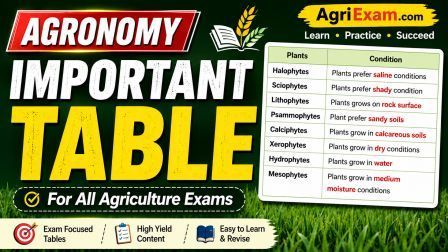
6.Plants and their conditions
| Plant Type | Condition / Habitat |
|---|---|
| Halophytes | Plants that grow well in saline conditions. |
| Sciophytes | Plants that grow well in shady or low-light conditions. |
| Lithophytes | Plants that grow on rocks or rocky surfaces. |
| Psammophytes | Plants that grow well in sandy soils. |
| Calciphytes | Plants that grow well in calcium-rich or calcareous soils. |
| Xerophytes | Plants adapted to dry or desert conditions. |
| Acidophiles | Plants that grow well in acidic soils or acidic conditions. |
| Hydrophytes | Plants adapted to growing in or near water. |
Easy Memory Trick
- Halophytes → Salt
- Sciophytes → Shade
- Lithophytes → Rocks
- Psammophytes → Sand
- Calciphytes → Calcium
- Xerophytes → Dry
- Acidophiles → Acid
- Hydrophytes → Water
Agronomy Important Table
| More Agronomy Study Material | Open |
| More Agriculture Study Material | Open |
| Premium Study Material & Test Series | Open |


Crops new varieties
Very nice…..
Crops spacing recommendation..sir
Very useful.. .. Thank you so much. .
Ph of important crops
Yes of course
Very nice and useful for AFO exam
Crop spacing are needed sir. Plz send it
Very useful and great.
Plz add 1 ph tabla
Please check Agronomy and horticulture table we already added ph of all crops
I want to buy course for iffco agt plz give me guidence
Very useful information Regarding any Agricultural exam
Thnk u Agri Exam Team
Agriculture SOPRWAJAR Raj. In question
Most important and useful questions point of view exam
Most important and useful questions point of view exam
Thank you
Very nice & Useful contents. Thanx.
Bahut he badeya