The Taungya system is a modified form of shifting cultivation where agricultural crops are grown between rows of young forest trees during the early stages of establishment
Origin: The word Taungya is derived from the Burmese language, where taung means “hill” and ya means “cultivation” (coined in Burma around 1850).
Q.554. The scientific name of erect type of groundnut is?
(मूंगफली के erect प्रकार का वैज्ञानिक नाम क्या है?)
Explanation:- The head office of the National Bank for Agriculture and Rural Development (NABARD) is located in Mumbai, Maharashtra.
NABARD – National Bank for Agriculture and Rural Development
Established: 12 July 1982 Headquarters: Mumbai, Maharashtra Ownership: Fully owned by the Government of India Basis: NABARD Act, 1981, following the recommendations of the B. Sivaraman Committee (CRAFICARD).
Main Role
NABARD is the apex development financial institution for promoting agriculture and rural development in India.
Core Functions
Refinance
Rural Development
Supervision
Financial Inclusion
Infrastructure Development
Q.560. Regular bearing variety of mango is?
(नियमित फलन वाली आम की किस्म कौन-सी है?)
Amarapali
Langra
Mallika
Dashehari
Answer:- 1. Amarapali
Explanation:- Amrapali is a regular-bearing, dwarf mango variety developed from Dashehari × Neelum.
Regular-Bearing Mango Varieties
These mango varieties are known for consistent/regular annual bearing:
Arka Niketan is a high-yielding, premium onion variety developed by the Indian Institute of Horticultural Research (IIHR), Bangalore
Q.563. Which type of seed is directly used by farmers for commercial crop production?
(व्यावसायिक फसल उत्पादन के लिए किसान सीधे किस प्रकार के बीज का उपयोग करते हैं?)
Foundation seed
Breeder seed
Nucleus seed
Certified seed
Answer:- 4. Certified seed
Explanation:- Certified Seed is the seed class generally supplied to farmers for commercial crop production. It is produced from Foundation Seed under prescribed standards of seed certification to maintain genetic purity, physical purity, and quality.
Q.564. The weed Echinochloa colona is commonly associated with which crop?
(Echinochloa colona खरपतवार सामान्यतः किस फसल के साथ पाया जाता है?)
Maize
Rice
Jowar
Bajra
Answer:- 2. Rice
Explanation:- Echinochloa colona, commonly called jungle rice, is an important weed of rice fields.
Key Agronomic Facts for AgriExams
Parameter
Exam-Oriented Fact
Scientific Name
Echinochloa colona (L.) Link
Common Names
Jungle rice, Awnless barnyard grass, Deccan grass
Family
Poaceae (Gramineae)
Life Cycle & Type
Summer annual C4 grass
Primary Habitat
Upland and rainfed lowland rice fields (prefers moist but unflooded soils)
Ancestor of Crop
It is the wild ancestor of Sawa millet (Echinochloa frumentacea).
Q.565. The colour of lower triangle in highly toxic insecticide labels is?
(अत्यधिक विषैले कीटनाशी के लेबल में निचले त्रिभुज का रंग क्या होता है?)
Blue
Red
Green
Yellow
Answer:- 4. Yellow
Explanation:- In the older Indian pesticide colour-coding system, yellow indicates highly toxic pesticides.
Classification of insecticides
Classification of insecticides
Oral acute toxicity LD₅₀ (mg/kg body weight)
Dermal toxicity LD₅₀ (mg/kg body weight)
Identification band colour
1. Extremely toxic
1–50
1–200
Bright red
2. Highly toxic
51–500
201–2000
Bright yellow
3. Moderately toxic
501–5000
2001–20,000
Bright blue
4. Slightly toxic
More than 5000
More than 20,000
Bright green
Easy way to remember: 🔴 Red → Extremely toxic 🟡 Yellow → Highly toxic 🔵 Blue → Moderately toxic 🟢 Green → Slightly toxic
Q.566. The National Seed Corporation (NSC) was established in the year?
(राष्ट्रीय बीज निगम (NSC) की स्थापना किस वर्ष हुई थी?)
1966
1945
1979
1963
Answer:- 4. 1963
Explanation:- The National Seeds Corporation (NSC) was established in 1963 to support the production and distribution of quality seeds.
Question
Answer
Father of Indian Seed Technology / Seed Industry
Dr. B. R. Barwale
Father of Seed Testing
Friedrich Nobbe
National Seeds Corporation (NSC) established
1963
NSC started functioning
July 1963
Indian Seeds Act enacted
29 December 1966
Seeds Rules
1968
Indian Patents Act
1970
Seeds (Amendment) Act
9 September 1972
National Seed Project (NSP) established
1976
Seeds (Control) Order
1983
National Seed Policy
2002
Headquarters of National Seeds Corporation
New Delhi
First state to establish an official Seed Certification Agency (1970)
Maharashtra
First state to establish an autonomous Seed Certification Agency (1974)
Karnataka
ISTA established
10 July 1924
ISTA headquarters
Zurich, Switzerland
Q.567. The process of removal of husk in rice is known as?
(धान से भूसी हटाने की प्रक्रिया को क्या कहते हैं?)
Polishing
Hulling
Parboiling
Winnowing
Answer:- 2. Hulling
Explanation:-
The process of removal of the outer husk from rice (paddy) is known as hulling (also referred to as dehusking or dehulling).
Hulling: “The process of removing husk in rice is known as hulling.” It strips the hard outer hull/husk from rough paddy rice to produce brown rice.
Polishing: A subsequent milling step that removes the inner bran layers and germ to produce white rice.
Winnowing: The physical method of using wind or airflow to separate the already-loosened, lighter chaff/husk from the heavier grains.
Q.568. Who is known as the Father of Zero Budget Natural Farming (ZBNF)?
(शून्य बजट प्राकृतिक खेती (ZBNF) के जनक के रूप में किसे जाना जाता है?)
De Candolle
B. P. Pal
Williams
Subhash Palekar
Answer:- 4. Subhash Palekar
Explanation:-
Subash Palekar (Indian Agriculturist and Padma Shri Recipient) is the father of Zero Budget Natural Farming. He developed it in the mid-1990s as an alternative to the Green Revolution methods.
Q.569. Find the correct match.
(सही मिलान का चयन कीजिए।)
Green Revolution — i. Foodgrain production
White Revolution — ii. Milk production
Blue Revolution — iii. Fish production
Yellow Revolution — iv. Oilseed production
A. A-i, B-ii, C-iii, D-iv B. A-iii, B-i, C-iv, D-ii C. A-ii, B-iv, C-iii, D-i D. A-iv, B-ii, C-i, D-iii
Answer:- 1. A-ii, B-iv, C-i, D-iii
Explanation:- Green Revolution is associated with foodgrains, White Revolution with milk, Blue Revolution with fish, and Yellow Revolution with oilseeds.
Q.570. Seed coat is derived from?
(बीजावरण (Seed Coat) किससे विकसित होता है?)
Embryo
Testa
Endosperm
Nucleus
Answer:- 2. Testa
Explanation:- The seed coat develops from the integuments of the ovule, with the outer integument forming the testa.
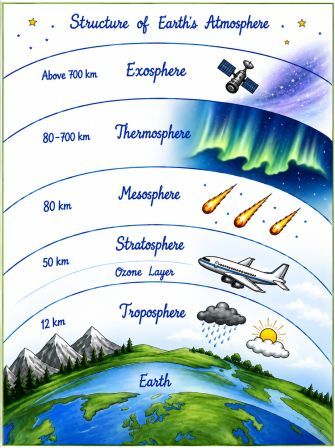
Q.571. The ozone formation is occurring in?
(ओजोन का निर्माण किस वायुमंडलीय परत में होता है?)
Troposphere
Stratosphere
Mesosphere
Thermosphere
Answer:- 2. Stratosphere
Explanation:- Most atmospheric ozone is formed in the stratosphere when ultraviolet radiation splits oxygen molecules and produces ozone.
Layer Name
Altitude Range (Approx.)
Temperature Trend
Main Composition/Features
1. Troposphere
0 – 12 km
Decreases with height
Nitrogen, oxygen, water vapour
2. Stratosphere
12–50 km
Increases with height
Ozone layer, dry air
3. Mesosphere
50–85 km
Decreases with height
Thin air, CO₂, O₂, N₂
4. Thermosphere
85–700 km
Increases with height
Ionized gases
5. Exosphere
700 – 10,000 km
Nearly constant/variable
Hydrogen, helium
Q.572. The natural source of water is?
(जल का प्राकृतिक स्रोत क्या है?)
River
Canals
Rainfall
Lake
Answer:- 3. Rainfall
Explanation:- Rainfall is the primary natural source of water that replenishes rivers, lakes, groundwater and soil moisture.
Q.573. The lowest layer of the atmosphere is?
(वायुमंडल की सबसे निचली परत कौन-सी है?)
Troposphere
Stratosphere
Mesosphere
Thermosphere
Answer:- 1. Troposphere
Explanation:- The troposphere is the lowest atmospheric layer and contains most of the atmosphere’s water vapour and weather phenomena.
Q.574. The surface of the lowest albedo is?
(सबसे कम अल्बीडो वाली सतह कौन-सी है?)
Soil
Water
Vegetation
Ice
Answer:- 1. Soil
Explanation:- Among the given options, soil generally has a lower albedo than vegetation and ice, depending on its colour and moisture status.
Q.575. The average rainfall in India has been estimated to be?
(भारत में औसत वर्षा कितनी अनुमानित की गई है?)
1194 mm
1294 mm
1394 mm
1094 mm
Answer:- 1. 1194 mm
Explanation:- The long-term average annual rainfall of India is commonly given as approximately 1194 mm.
Q.576. Tensiometers are suitable for which soils?
(टेंसियोमीटर किस प्रकार की मृदा के लिए उपयुक्त होते हैं?)
Clayey
Sandy
Silty
All of the above
Answer:- 2. Sandy
Explanation:- Tensiometers are particularly useful in sandy and coarse-textured soils for measuring soil-water tension in the readily available range.
Q.577. The eco-friendly insecticide is?
(पर्यावरण-अनुकूल कीटनाशी कौन-सा है?)
Thiodan
Malathion
Nimbicidine
Permethrin
Answer:- 3. Nimbicidine
Explanation:- Nimbicidine is neem-based and is considered an eco-friendly botanical insecticide used in integrated pest management.
Q.578. The insecticide safely recommended on vegetables is?
(सब्जियों पर सुरक्षित रूप से अनुशंसित कीटनाशी कौन-सा है?)
Aldicarb
Endrin
Malathion
Carbaryl
Answer:- 3. Malathion
Explanation:- Malathion has historically been recommended for several vegetable pests when used according to approved crops, doses and pre-harvest intervals.
Q.579. Which is used for seed treatment against sucking pest management?
(चूसक कीटों के प्रबंधन हेतु बीज उपचार में किसका उपयोग किया जाता है?)
Endrin
Diazinon
Fenvalerate
Imidacloprid
Answer:- 4. Imidacloprid
Explanation:- Imidacloprid is a systemic neonicotinoid insecticide commonly used as seed treatment against early-season sucking pests.
Q.580. Which of the following Indian States is popularly known as ‘Garden of Spices’?
(निम्नलिखित में से किस भारतीय राज्य को ‘Garden of Spices’ के नाम से जाना जाता है?)
Tamil Nadu
Karnataka
Kerala
Andhra Pradesh
Answer:- 3. Kerala
Explanation:- Kerala is famous for its extensive production of spices and is popularly associated with the title ‘Garden of Spices’.
Q.581. Which of the following has the highest requirement of water?
(निम्नलिखित में से किस फसल को पानी की सबसे अधिक आवश्यकता होती है?)
Rice
Maize
Potato
Sugarcane
Answer:- 4. Sugarcane
Explanation:- Sugarcane is a long-duration, high-water-requiring crop and generally needs more water than the other listed crops.
Water Requirements of Major Crops
Rice (Paddy):1200–2500 mm (120–250 cm) total water depth needed for full maturity.
Sugarcane:1500–2500 mm (or up to 2200–3000 mm depending on the region), representing one of the highest water-requiring field crops.
Wheat:450–650 mm (45–65 cm) across its typical growing period.
Maize & Sorghum:500–600 mm to complete grain development.
Groundnut:500–550 mm, with critical needs during the pegging stage.
Key Exam Definitions
Delta (Δ): The total water depth required by a crop to attain its full maturity in its base period.
Duty (D): It is the number of hectares of land irrigated for full growth of a given crop by a supply of 1 cumec of water continuously during the entire base period of that crop.
Consumptive Use: The amount of water used by crop evapotranspiration (evaporation from surrounding soil plus plant transpiration).
Q.582. Which one is a seedless variety of mango?
(निम्नलिखित में से आम की बीजरहित किस्म कौन-सी है?)
Arka Puneet
Amrapali
Mallika
Sindhu
Answer:- 4. Sindhu
Explanation:- Sindhu is a mango variety known for its very low fibre content and seedless or nearly seedless fruit character.
Sindhu is the seedless variety of Mango. • It is a cross between Ratna × Alphonso. • It is a regular bearer, medium-sized, free from spongy stone.
Additional Information
• Mango is known as the national fruit of India/king of fruits. • Fruit type of mango: Drupe/stone • Origin of mango: Indo-Burma • Edible part: Mesocarp • India’s rank in mango production: First
Q.583. Which of the following is the largest coconut producing state in India?
(भारत में नारियल का सबसे बड़ा उत्पादक राज्य कौन-सा है?)
Maharashtra
Madhya Pradesh
Kerala
Rajasthan
Answer:- 3. Kerala
Explanation:- Kerala has traditionally been one of India’s leading coconut-producing states due to its favourable tropical climate.
Q.584. ‘Red rust of tea’ is caused by?
(‘Red rust’ चाय का रोग किसके कारण होता है?)
Bacteria
Fungi
Algae
Virus
Answer:- 3. Algae
Explanation:- Red rust of tea is caused by the parasitic alga Cephaleuros parasiticus.
Q.585. Edible part of apple is?
(सेब का खाने योग्य भाग क्या है?)
Endosperm
Cotyledon
Fleshy thalamus
Pericarp
Answer:- 3. Fleshy thalamus
Explanation:- Apple is a pome fruit in which the fleshy edible portion develops mainly from the thalamus or receptacle.
Explanation:- Arka Navneet is an improved variety of brinjal developed for cultivation in India.
Q.592. National Research Centre for Litchi (NRCL) is located at?
(राष्ट्रीय लीची अनुसंधान केंद्र (NRCL) कहाँ स्थित है?)
Pune
Muzaffarpur
Lucknow
Kolkata
Answer:- 2. Muzaffarpur
Explanation:- ICAR-National Research Centre on Litchi is located at Muzaffarpur, Bihar, a major litchi-growing region.
Q.593. The word “Horticulture” is derived from?
(“Horticulture” शब्द किस भाषा से लिया गया है?)
Latin
English
Greek
Italic
Answer:- 1. Latin
Explanation:- Horticulture is derived from the Latin words hortus meaning garden and cultura meaning cultivation.
Q.594. Bhadawari buffalo is identified by which one body colour?
(भदावरी भैंस की पहचान किस शरीर के रंग से होती है?)
Black
Copper
Light black
Grey
Answer:- 2. Copper
Explanation:- Bhadawari buffalo is characteristically identified by its copper or copper-brown body colour and is known for high milk-fat content.
Bhadawari Buffalo
I.Copper coloured hair skin.
II. Age at first calving 50 months.
III. The average milk yield is 800 to 1100 kg.
IV. Two white lines ‘Chevron’ are present at the lower side of the neck similar to that of Surti buffaloes.
V. The fat content varies from 6 to 13 percent (Maximum fat).
Q.595. Ranikhet disease affects?
(रानीखेत रोग किसे प्रभावित करता है?)
Cattle
Pig
Fish
Poultry
Answer:- 4. Poultry
Explanation:- Ranikhet disease, also called Newcastle disease, is a highly infectious viral disease primarily affecting poultry.
Q.596. Where is the Central Institute of Research on Goats located?
(केंद्रीय बकरी अनुसंधान संस्थान कहाँ स्थित है?)
Mathura
Pantnagar
Anand
Hissar
Answer:- 1. Mathura
Explanation:- ICAR-Central Institute for Research on Goats (CIRG) is located at Makhdoom, near Mathura, Uttar Pradesh.
Q.597. The edible part of Knol-Khol is?
(नॉल-खोल का खाने योग्य भाग क्या है?)
Root
Stem
Leaf
Flower
Answer:- 2. Stem
Explanation:- Knol-khol is a modified swollen stem that forms the main edible portion of the crop.
Q.598. The temporary roots in maize root system are?
(मक्का की जड़ प्रणाली में अस्थायी जड़ें कौन-सी होती हैं?)
Seminal roots
Coronal roots
Aerial roots
Crown roots
Answer:- 1. Seminal roots
Explanation:- Seminal roots develop from the seed embryo and function mainly during the early stages of maize growth before the nodal root system becomes dominant.
Q.599. What is the seed rate of composite maize?
(Composite maize की बीज दर कितनी होती है?)
25–30 kg/ha
18–20 kg/ha
10–15 kg/ha
20–25 kg/ha
Answer:- 2. 18–20 kg/ha
Explanation:- The commonly recommended seed rate for composite maize is about 18–20 kg per hectare under suitable planting conditions.
One Request 👉 यदि यह पोस्ट आपको उपयोगी लगे, तो कृपया इसे साझा करें, ताकि अधिक से अधिक कृषि छात्रों को लाभ मिल सके। 🌾
This post is made with dedication to help Agriculture students in their studies. If it adds value to you, please share it so more students can benefit. 🌾📚