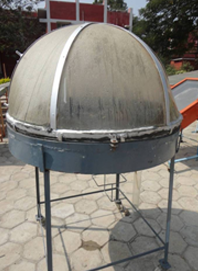
Bathing, Coffee / Tea preparation, Dishwashing etc.
Industrial
Pre-heating of boiler feed water, cooking / dishwashing in industrial canteens. washing of milk canes in dairies, sterilisation of surgical instruments etc.
Economics (Tentative)
A 100 lpd domestic solar water heating system (SWHS) can cater to a family of 5 persons and costs about Rs.20000.
A 1000 lpd industrial system would cost about Rs.2.0 lakhs and would have a payback period of 2 years.
It saves about 1500 units of electricity per annum equivalent to about Rs.5000/- per year
General Information
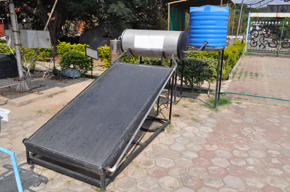
Solar water heating system (SWHS) has three main components, namely, Solar Collector, Insulated hot water storage tank and Cold water tank with required insulated hot water pipelines and accessories.
In the case of smaller systems (100 – 2000 litres per day), the hot water reaches the user end, by natural (thermo – siphon) circulation for which the storage tank is located above the collectors.
In higher capacity systems, a pump may be used for forced circulation of water. A bank of collectors can be arranged in a series – parallel combination to get higher quantity of hot water.
A typical 100 litres insulated tank with a 2 m2 collector area, will supply water at a temperature of 60 – 80°C.
The tanks are generally made of stainless steel to avoid corrosion and are insulated to reduce heat losses.
3.Solar Distillation Plant
Function
Converting salt water into potable water
Specification
Area
15 m2
Concrete
1:5:10
Wearing coat
1:1.5:3 (7.5 cm thick black coated)
Side walls
Brick masonry
Distilled water collecting channel
Aluminium
Tank
Two numbers in brick masonry structure
Cost of operation
Rs.6/h
General Information
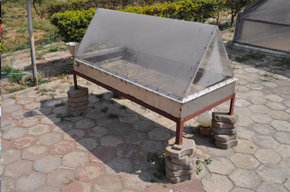
The unit is a basin type solar distillation plant of masonry construction, with a basin area of 15 m2& slope of the glass cover is 15°.
Salient features
The still can yield 3 to 4 liters of distilled water per square meter area of the basin in a day.
4.Step type Solar dryer
Function
Drying of fruits, vegetables and agricultural commodities
Specification
Collector area
2.4 x 1.8 m
Number of trays
10 in five steps
Insulation (Bottom)
Glass wool, 10 cm. thick
Motive power
Natural convection
Cost of the unit (approx)
Rs.15000/-
Cost of operation
Rs.3.75/h.
General Information
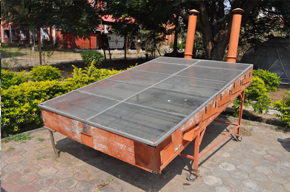
Step type solar dryer has a collector area of about 4.32 m2.
This multi track step type dryer can hold 10 aluminium trays at a time.
The absorber is 20 gauge GI sheet, black painted at the top with bottom insulation.
Salient features
Solar drier takes 40 hours for drying 50 kg of papaya leather, while conventional sun drying takes 61 hours. Thus there is a saving of 21 hours which is 35% when compared to conventional drying.
The drier handles 10 kg of cocoon per batch and each batch takes 30-40 minutes for completion of stifling. 80 kg of cocoon per day in 8 batches can be conveniently stifled in a day.
Renewal Energy Important Study Content
5.Solar Tunnel Dryer for Agro Industrial Applications
Function
Natural convection walk-in type dryer for bulk drying of agricultural & agro industrial products at moderate air temperature.
Specifications
Semicylindrical shaped tunnel with a base area of 3.75 m x 18 m for capacity of 1 ton per batch for drying of sago and coconut Metallic frame structure of tunnel dryer is covered by UV stabilized semi transparent polythene sheet of 200 micron thickness.
Length of the dryer depends upon type and quantity of the product to be dried per batch. A slope of 10-15o is provided along the length of the tunnel.
Cost (approx)
Rs 1, 20,000 for standard size (3.75m x 18.0m)
Salient features
Maximum mean temperature obtained inside the dryer is 57° C while the ambient temperature was 33.5 °C.
The drying time for sago drying in solar tunnel dryer is 5 h ours with 20% cost saving when compared to open sun (11 hours drying time) method.
Payback period is 5.8 years for sago product.
The savings in drying time using coconut as produce is 16 hours, with 42 % cost saving when compared to open sun drying method.
This tunnel dryer can also be useful for drying of chillies.
6.Solar Lantern
Configuration
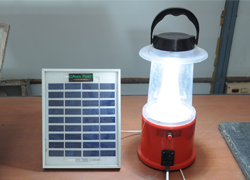
SPV (Solar PhotoVoltaics) lantern is a portable lamp.
It consists of SPV module of 10 Wp capacity, rechargeable battery, Compact Fluorescent lamp (CFL) of 5 / 7 W and electronics (i.e. inverter and charge controller ).
When sunlight falls on the SPV module, it is converted into DC electricity, which is stored in a battery and converted into AC electricity by the inverter and used for supplying power to CFL.
If charged regularly, it can be used for 4 hours daily.
Potential for use
Individuals
Remote households, farm operations, emergency (portable) lamp, fly catchers etc.
Industries
Emergency lamps in factories, offices, canteens, security gates etc.
SHGs
Lanterns may be provided to vendors on hire (daily) by Self Help Groups or small entrepreneurs.
Cost
Rs.3000 (tentative)
7.Solar Photovoltaic (SPV) Street Lights
Configuration
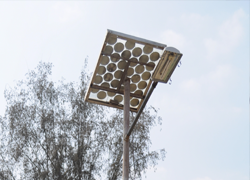
SPV street lighting system is a stand-alone system consisting of 74 W module, rechargeable battery, CFL lamp of 11 W, electronics (inverters & charge controller)
Street lights, parks, play fields, bus stands, bus shelters, petrol bunks, resorts etc.
Cost
Rs.25,000/- to Rs.35,000/- depending upon period of warranty.
8.Solar Water Pumps
Function
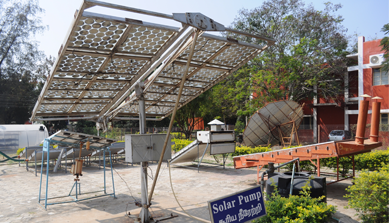
Drinking water supply for small habitations
Specification
Type
DC Surface & AC submersible
Capacity of DC Surface
900 Wp – 1 Hp & 1800 Wp – 2 Hp
Capacity of AC submersible
1800 Wp – 0.75 Hp
Water Level Depth (maxi) of DC Surface
14 meter
Water Level Depth (maxi) of AC submersible
50 meter
Discharge Rate of 1 Hp Capacity of DC Surface
75 000/ day (litres)
Discharge Rate of 2 Hp Capacity of DC Surface
1 40 000/ day (litres)
Discharge Rate of AC submersible
50000/ day (litres)
Collector area
2.4 x 1.8 m
Type
Step type
Number of trays
10 in five steps
Insulation (Bottom)
Glass wool, 10 cm. thick
Motive power
Natural convection
Salient features
Drinking water supply for small habitations
Horticulture farms, orchards, vineyards, gardens and nurseries
Agro forestry and plantations
Dairy, poultry and sheep farm
Aqua culture, fish farming
Renewal Energy Important Study Content
9.Solar Box Type Cooker
Function
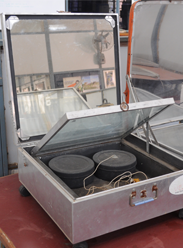
For cooking purposes where sunshine is available in plenty
Specification
Type
Box type
Overall dimensions L x B x H (mm)
500 x 500 x 200
Weight
12 kg
Time taken in cooking
35-40 min
Conversion efficiency for
Rice
45-60 %
Conversion efficiency for
vegetables
60-100 %
Salient features
A large number of items such as pulses, rice, kheer, khichri, vegetables, meat, fish etc. can be cooked in the solar cooker.
The time taken to cook will depend upon the type of food, time of the day and solar intensity.
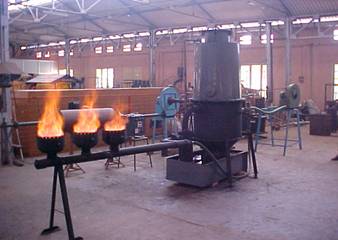
10.Wood Based Down Draft Gasifier
Function
For converting Fuel wood to fuel
Specification
Capacity
58 kW
General Information
Fuel consumption
20 to 25 kg/h
Gas production rate
50 m3/h
Thermal output
500000 kcal/h
Cost of the unit (approx)
Rs.1,50,000/-
Salient features
Fuel wood can be used as fuel
40% fuel saving due to higher thermal efficiency
No smoke
Best suited for processing industries with steam
Fulfill the heat energy requirement in rice mills, turmeric and arecanut processing units etc.
11.Deenabandhu Model Biogas Plant
Function
Household cooking, lighting and running engines
Specification
Components
Dome, Digester, Gas storage, Gas Outlet Pipe, Inlet and out let pipe
Feed material
cow dung, pig manure, poultry droppings etc.
Shape of the plant
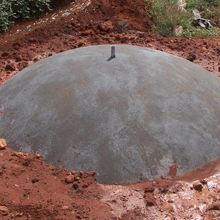
Dome model
General Information
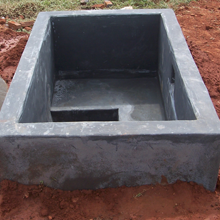
The entire plant is built with brick in cement mortar. Unlike janta Biogas plant it does not require any shuttering, thus reducing the cost of construction.
The hydraulic retention time for this design is 40 days for northern plains of the country. For hilly regions the retention time is about 50 days.
Salient features
1- 4 cum capacity in 1 to 2 days duration.
12.Community Biogas Plant
Function
Cooking, lighting and running engines
Specification
Gas volume
35 m3
Gas holder height
1.0 m
Inlet/outlet opening
2.0 x 1.2 m
Initial dung required
32 to 36 tonnes of cowdung
Daily loading rate
800 to 900 kg
No. of cattle required
80 to 90 animals
Cost of the unit (approx)
Rs. l,50,000/-
Cost of operation
Rs. l 00/day
General Information
The community level biogas plant will be constructed in a common place, the feed material will be collected from a group of households and the produced biogas will be distributed to all the beneficiaries.
Salient features
Rate of biogas production :1.5 m3/h
No. of hours 5 hp dual fuel engine can run: 14 h
Electricity production potential : 40 kWh
No. of beneficiaries for Cooking gas : 40 – 50 families
Renewal Energy Important Study Content
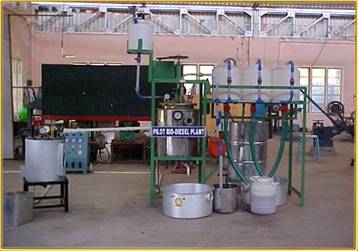
13.Biodiesel Manufacturing Plant
Function
Production of biodiesel from vegetable oils
Specification
Capacity
250 kg oil/day
Command area required
25 ha
Biodiesel production
250 L/day
Glycerol production
55 kg/day
General Information
Biodiesel is produced from Jatropha oil by converting the triglycerides into methyl esters with a process known as transesterification.
Salient features
About 250 litres of biodiesel can be produced per day from vegetable oils or tree seed oils.
Glycerol (by-product), can be used further in soap making or in chemical industries.
One Request 👉 यदि यह पोस्ट आपको उपयोगी लगे, तो कृपया इसे साझा करें, ताकि अधिक से अधिक कृषि छात्रों को लाभ मिल सके। 🌾
This post is made with dedication to help Agriculture students in their studies. If it adds value to you, please share it so more students can benefit. 🌾📚