Fertilizers Classification
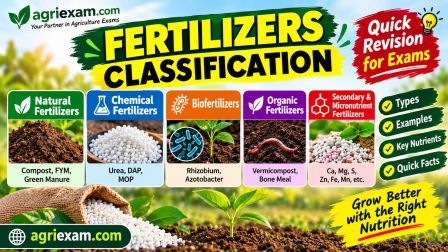
Fertilizers Classification | Types, Examples & Important Facts | Agriculture Exams
Q.1 Nitrogen content in calcium ammonium nitrate(CAN)? (IBPS AFO 2019)
- 25
- 21
- 30
- 32
- 40
Q.2 Which of the following doesn’t supply Nitrogen? (IBPS AFO 2019)
- Trichoderma viride
- Rhizobium
- Azolla
- Azotobacter
- Azospirillum
Classification of Fertilizers
Fertilizers are materials added to the soil or plant system to supply essential nutrients required for plant growth and development.
Main Classification
Fertilizers can be broadly classified into:
- Straight Fertilizers
- Compound Fertilizers
- Complex Fertilizers
- Mixed Fertilizers / Fertilizer Mixtures
- Biofertilizers
- Phosphobacterium
1) Straight Fertilizers
When a fertilizer contains and is used for supplying a single nutrient, it is called a straight fertilizer. This is further classified as nitrogenous, phosphatic and potassic fertilizers depending on the specific macro nutrient present in the fertilizer
Nitrogenous fertilizers
| Fertilizer | Nitrogen | other |
| Ammonium sulphate | 20.6% | S 24% |
| Ammonium chloride | 25-26% | Cl 66% |
| Ammonium nitrate | 33-34% | |
| Ammonium sulphate nitrate | 26% | |
| Anhydrous ammonia | 82% | |
| Calcium ammonium nitrate | 25% | Ca 8.1%, Mg 4.5% |
| Calcium nitrate | 15% | Ca 34% |
| Sodium nitrate | 16% | |
| Urea | 46% | |
| Calcium cynamide | 21% |
Phosphatic fertilizers
| Fertilizer | Phosphorus % |
| Water soluble phosphate | |
| Single superphosphate | 16% 12% S and 19% Ca |
| Double superphosphate | 32% |
| Triple superphosphate | 48% |
| Citric acid soluble phosphate | |
| Basic slag | 14-18% |
| Di-Calcium Phosphate | 34-39% |
| Insoluble phosphate | |
| Rock phosphate | 20-40% |
| Raw bone meal | 20-25% |
| Steamed bone meal | 22%–30% |
Potassic fertilizers
| Potassic fertilizers (potassium %) | |
| Muriate of potash (KCI) | 60% |
| Sulphate of potash (K2SO4) | 48–52% |
| Potassium nitrate (KNO3) | 44% |
Potassium chloride:- KCl
2) Compound Fertilizers
Compound fertilizers are the commercial fertilizers in which two or more primary nutrients are chemically combined.
| Fertilizer | N | P2O5 |
| Di ammonium phosphate (DAP) | 18% | 46% |
| Mono ammonium phosphate | 11% | 48% |
| Urea ammonium phosphate | 28% | 28% |
| Ammonium phosphate | 16% | 20% |
3) Complex Fertilizers
Complex fertilizers are the commercial fertilizers containing at least two or more of the primary essential nutrients at higher concentration in one compound. The nutrients in complex fertilizers are physically mixed.
Complex Fertilizers
| Fertilizer | N | P2O5 | K2O | |
| Complex fertilizers | 17 | 17 | 17 | MF |
| 14 | 28 | 14 | ||
| 10 | 26 | 26 | IFFCO | |
| 12 | 32 | 16 | ||
| 14 | 36 | 12 | ||
| Nitro-phosphate-potash | 15 | 15 | 15 | |
| Gromor | 14 | 35 | 14 |
4) Mixed Fertilizers/Fertilizer Mixtures
Definition: Fertilizers prepared by physically mixing two or more fertilizer materials without chemical reaction between them.
Features
- Nutrients are physically mixed.
- Components retain their individual properties.
- Can be prepared according to crop and soil requirements.
- Nutrient uniformity depends on proper mixing and handling.
Example: Physical mixture of nitrogenous, phosphatic and potassic fertilizers.
5) BIO FERTILIZERS
Definition: Biofertilizers are preparations containing beneficial living microorganisms that improve nutrient availability or fixation for plants.
Major Types
| Type | Examples | Main Function |
|---|---|---|
| Symbiotic N-fixers | Rhizobium | N fixation in legumes |
| Associative N-fixers | Azospirillum | N fixation |
| Free-living N-fixers | Azotobacter | N fixation |
| Cyanobacteria (BGA) | Anabaena, Nostoc | N fixation, especially in rice |
| Phosphate-solubilizers | Phosphobacteria | Improve P availability |
| Mycorrhiza | VAM/AM fungi | Improve P and micronutrient uptake |
Important Biofertilizers
Rhizobium → Leguminous crops
Azospirillum → Cereals and grasses
Azotobacter → Free-living N fixer
BGA → Rice/Paddy
Phosphobacteria → Phosphorus availability
VAM → Phosphorus uptake
Rhizobium
| Rhizobium species | Legumes |
| Rhizobium meliloti | Alfalfa (Lucerne) |
| Rhizobium trifolii | Clover |
| Rhizobium leguminosarum | Peas |
| Rhizobium phaseoli | Beans |
| Rhizobium lupine | Lupine |
| Rhizobium japonicum | Soybean |
| Rhizobium sp. | Cowpea |
Azolla It is a small water fern of worldwide distribution under natural conditionsThere are six species of Azolla. They are Azolla caroliniana, Azolla filiculoides, Azolla mexicana, Azolla nilotica, Azolla microphylla and Azolla pinnata.
Azolla contains 3.1-4.2% N; 0.16% P2O5 and 0.18% K2O on dry weight basis.
Azospirillum This bacterium is associated with cereals like rice, sorghum, maize, cumbu, ragi,tenai and other minor millets and also for cotton, sugarcane, oilseeds and fodder grasses. These bacteria colonizing in the roots not only
Azatobacter The beneficial effects of Azatobacter on plants was associated (non-symbiotically) not only with the process of nitrogen fixation but also with the synthesis of complex of biologically active compounds such as nicotinic acid, pyridoxine, biotin, gibberellins and probably other compounds which stimulate the germination of seeds and accelerate plant growth.
Azatobacter population in soil or near the root zone of crops (Rhizosphere) is very low when compared to other soil bacteria.
The nitrogen fixation potential of this bacterium is also not very high and appreciable (20 to 30 kg of N per ha per year).
Blue green algae- The blue green algae occur under a wide range of environmental conditions.
They are completely auto tropic and require light, water, free nitrogen (N2), carbon dioxide (CO2) and salts containing the essential mineral elements. They play a major role in the nitrogen economy of paddy soils in tropical countries. Different algal species available are:
• Tolypothric tenuis,
• Nostoc,
• Plectonema,
• Chlorococous,
• Aulosira fertilization,
• Anabaena, and
• Chorococcum
6) Phosphobacterium
Mycorrhizae (VAM) – Vesicular Arbiscular Mycorrhiza is a fungi used as bio-fertilizer.Mycorrhiza increases crop yield, protect against certain root pathogen, helps in uptake of P, Cu, Zn and B and increases tolerance to environmental stress.


Good information